Maison Augustin-Brisebois
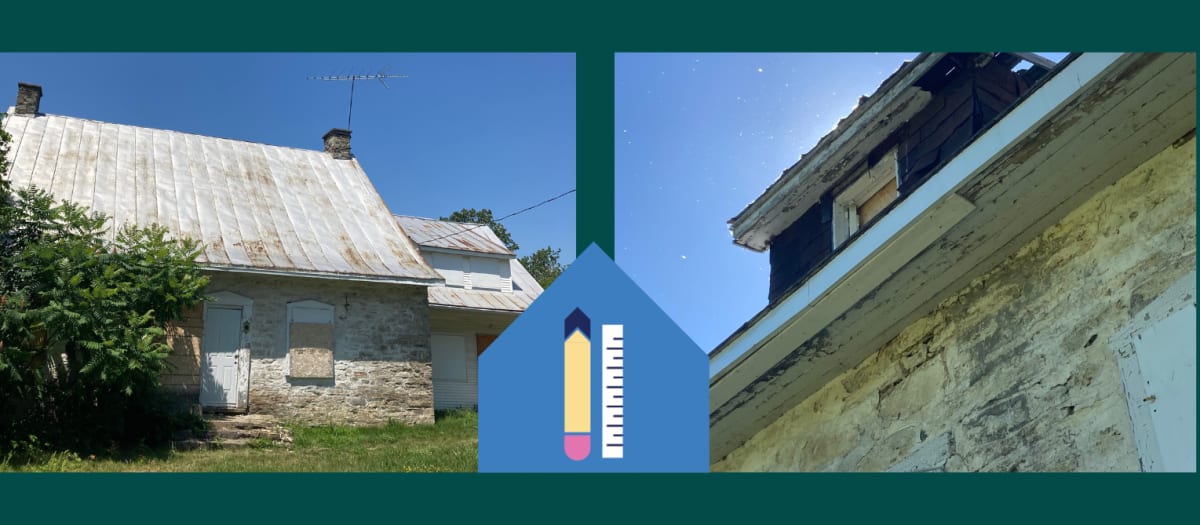
The Maison Augustin-Brisebois (formerly the Maison Gomes) is located on Boulevard Gouin, along the waterfront. The Pierrefonds-Roxboro borough, which has owned the property since 2018, is currently exploring options for redeveloping the site (including both the house and the land).
Background
Although the house does not have official status under the Cultural Heritage Act, it is recognized as an exceptional heritage building in the 2050 Land Use and Mobility Plan. It stands as a significant testament to Montreal’s agricultural past and is listed in the inventory of historic farmhouses. The building is notable for:
- Its architectural authenticity;
- The quality of its surroundings;
- Its representation of rural architecture from the late 18th and early 19th centuries.
After several years of neglect, punctuated by safety measures, restoration and renovation work is now being planned.


Steps and Timeline
Archaeological research is needed to better understand the site’s history before taking any action.
With this in mind:
- An archaeological excavation, supported by historical research, will be carried out.
- This project will be carried out by Arkéos, a firm specializing in anthropological research.
- The work will take place from June 15 to July 10, 2026 (subject to change depending on weather and site conditions).
- The archaeological project is being carried out as part of the 2024–2027 Montréal Cultural Development Agreement between the Ministry of Culture and Communications and the City of Montréal.
The site holds significant archaeological potential for the borough, as evidenced in particular by:
- The proximity of the Rivière des Prairies, suggesting that Indigenous people lived in the area long ago;
- Historical records documenting land grants dating back to 1730–1750.
The plot of land was once part of a larger tract granted by the Sulpicians in the early 17th century.
The house is named after Augustin Brisebois (1765–1831), a member of a family of farmers who owned the property from 1767 to 1877.
According to the City of Montréal’s property assessment roll, the building is estimated to have been constructed in 1830. However, preliminary research suggests that the building may be older.
Historical research and archaeological investigation will make it possible to:
- Determine the date of the house’s construction;
- Identify outbuildings and facilities associated with:
- agricultural operations
- domestic uses.
- Document the site’s occupation (including potential Indigenous occupation);
- Gain a better understanding of the property’s historical spatial layout.
At this stage, a survey will be distributed to involve the public in the planning process. The call for contributions has two distinct objectives:
- To invite the public to share memories, photos, and personal accounts;
- To collectively reflect on the future site.
Thanks to the public’s involvement at this stage, the project is developed in collaboration with the community, allowing for the creation of a plan that aligns with the specific needs of the area.
This is not only of an effort to showcase our built heritage, but also of an effort to showcase the human heritage of our borough.
The team in charge of the project is compiling the results of the survey, the archaeological and historical studies that have been conducted, and the recommendations from experts in order to begin an in-depth analysis of the site.
At this stage, future uses are determined to breathe new life into a place steeped in history.
The heritage statement highlights the historical, symbolic, artistic, social, and technical values of a site and identifies the characteristics that express them.
It preserves the region’s history and enriches our understanding of the past.
The Urban Planning and Mobility Department (SUM), through its Heritage Division, assists the borough, particularly in preparing a statement of heritage significance for the building.
Based on the results of the survey, archaeological and historical studies, recommendations from experts, and the heritage statement, the project team is developing guidelines for the site’s development.
This phase aims to define an overarching vision that reconciles the preservation of the site’s heritage values with its enhancement and integration into the community’s current and future needs.
The selected guidelines will serve as a framework for the subsequent phases of planning, design, and implementation of the project, in order to ensure the sustainability and enhancement of this site of historical and heritage significance.
The timeline for the work on the Augustin-Brisebois House is unknown.
Issues and Scope
This project represents a strategic opportunity to:
- Invite the public to reimagine a space for themselves;
- Document a site of significant historical and archaeological value;
- Provide informed guidance for restoration efforts;
- Support future cultural and heritage initiatives;
- Contribute to the preservation of Montreal’s agricultural heritage.
Quick search
Need help?
Contact us if you have questions.