Québec’s First Industrial TOD in Saint-Laurent’s Hodge-Lebeau Sector

Saint‑Laurent is developing a new vision to support the gradual transformation of the sector into a modern, innovative and better-connected industrial hub, while incorporating certain principles of transit-oriented development (TOD) adapted to the industrial context.
Saint-Laurent’s municipal administration has developed a master plan for the redevelopment of this aging industrial sector located in the southeastern part of its territory.
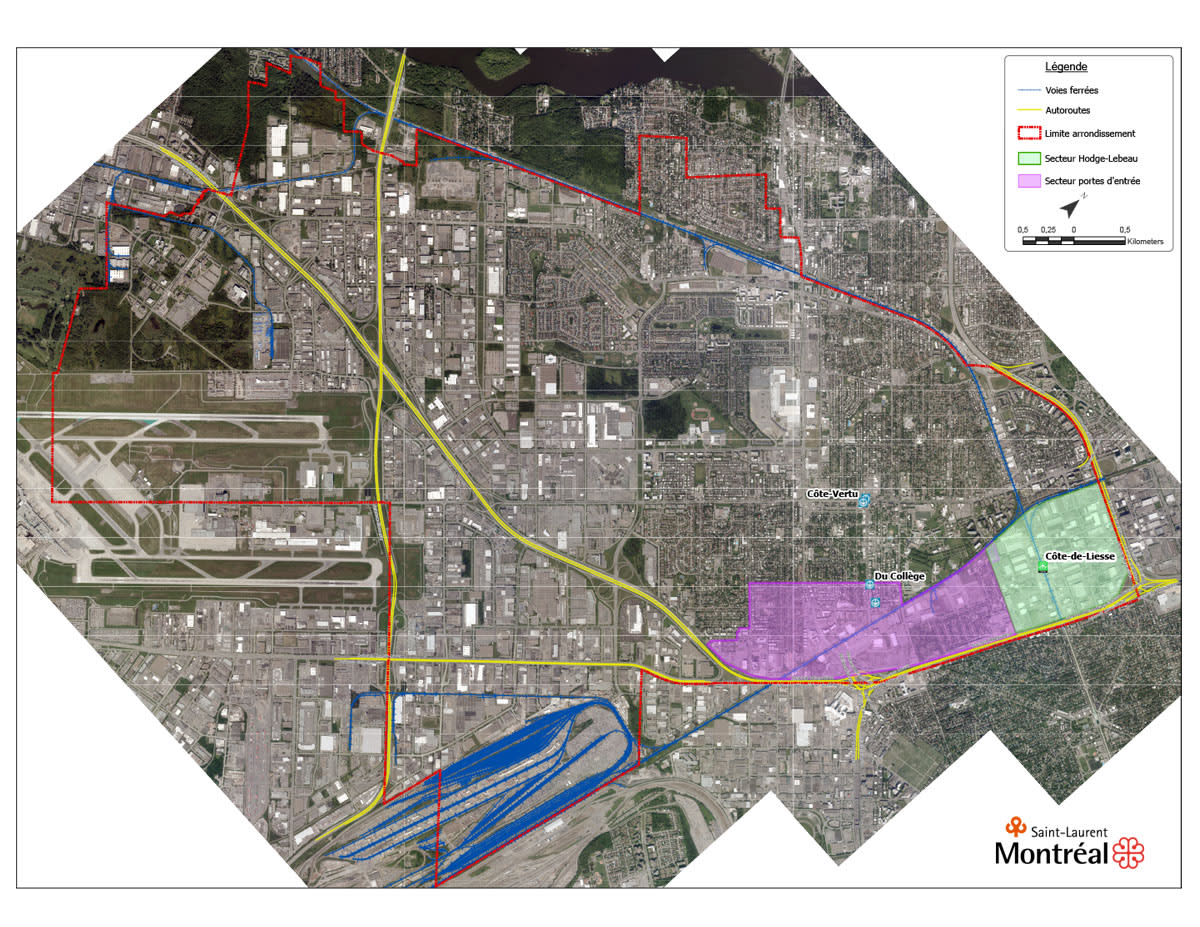
Adjacent to the western gateways sector, this area is separated in the middle by the REM line and is enclosed between Autoroutes 40 and 15 and the Canadian National (CN) railway line. It is primarily made up of large warehouses and industrial plants, bringing together more than 150 businesses.
The proposed vision incorporates certain principles of transit-oriented development (TOD) adapted to the industrial context. The changes will be implemented in phases over the long term, leading up to 2050.
This page will be updated regularly to highlight the progress made along the way.

Why this plan?
Hodge-Lebeau is a major employment sector, served since November 2025 by the Côte-de-Liesse REM station. The plan aims to facilitate travel to the station, make walking and cycling routes safer, improve coexistence among and with logistics stakeholders, and create public spaces for employees to wait and take breaks. The vision consists of creating a highly efficient industrial innovation sector for businesses and a pleasant environment for the people who work and spend time there.
Main proposed changes
- Creation of a hub for innovation, mobility and economic development around the Côte-de-Liesse REM station, including:
- a 6,000-square-metre public square for people to get their bearings, wait and get together
- landscaping and an event space
- a pedestrian and cycling overpass above the railroad tracks
- two buildings for businesses, retail spaces and services
- Rue Hodge would be transformed into a clearer and safer route to the REM: one-way traffic heading east, two protected one-way bike lanes, widened sidewalks and enhanced tree lines
- The consolidation of certain activities, such as warehousing and parking
- An exclusively pedestrian path to the east in the heart of the industrial mega-blocks, directly connecting Wright and Deslauriers streets to Rue Lebeau, allowing for a simple, uncongested, safe east-west crossing lined with trees and green spaces
- More nature in built-up areas: planted strips, rows of trees, ecological water management (river branches, ponds) as well as plant screens along the railroad tracks and autoroute.
Where is it happening?
What are the benefits for businesses?
- Easier access for employees: The REM station is located in the heart of the sector and the active transportation network (bike lanes and pedestrian walkways) is more user-friendly, continuous and connected (Hodge, east path, connections to Lebeau/Benjamin-Hudon). This means shorter and safer routes to building entrances.
- Optimized logistics and deliveries: clear prioritization of traffic routes and equitable sharing of the road (trucks, pedestrians and cyclists), safe intersections and shared-use rules (markings, crossing points) along key streets, with the objective of reducing conflicts of use and improving traffic flow
- Increased value of land and buildings through vertical densification and a high-quality built environment with a low carbon footprint
- Potential new economic synergies: shared use of facilities and infrastructure, and strengthened academic and business ties
- Enhanced image and increased appeal: the modernization of business activities toward Industry 5.0, well-maintained facades along major thoroughfares, an attractive public square, increased greening and an improved street atmosphere create a more pleasant environment for recruiting and retaining talent.
What are the benefits for local residents and workers?
- A new range of local services and commercial establishments, particularly on Rue Hodge and around the REM station, with lively ground-floor activity
- A shared-parking solution for employees and visitors through co-use parking facilities
- Direct, protected pathways to the REM station (Rue Hodge, overpass) and throughout the sector (Wright–Deslauriers–Lebeau pathway)
- Public spaces for resting, waiting and getting one’s bearings (a central square of approximately 6,000 m² surrounding the station)
- Safety and comfort: wider sidewalks, separate bike lanes, clearly marked crossing points and green spaces to reduce heat islands.
When can these changes be seen?
The plan provides an overview and a framework for the coming years. The projects will be carried out in several phases spanning the next two decades. Some aspects can be implemented more quickly (signage, pedestrian and cyclist amenities, landscaping), while others will require design, coordination or even consultation phases (overpass, central square, shared parking). Updates to the schedule will be posted on this page.
Frequently asked questions :
What is an industrial TOD?
A TOD (transit-oriented development) is a medium- to high-density real estate development centred around a high-capacity public transit station. A TOD is a neighbourhood that combines, among other things, active transportation, social diversity and urban design.
In the case of the Hodge-Lebeau sector, it is an industrial TOD because it organizes an industrial sector—including jobs—around a public transit station (in this case, the REM), while taking into account the constraints of a productive environment (trucks, loading/unloading docks, deliveries). The objective is to facilitate access for workers, ease traffic flow, and improve coexistence between logistics stakeholders on the one hand and pedestrians and cyclists on the other (bike lanes, sidewalks, crossing points).
Will trucking still be possible in the area?
Yes. The plan proposes to redesgin access roads and intersections in order to improve traffic flow, while protecting pedestrians and cyclists (through markings, barriers and clear signage). The objective is to ensure safer shared use, not to exclude productive activities.
Will pedestrians and cyclists be separated from trucks and cars?
Yes. The objective is to separate traffic flows (protected bike lanes, clearly marked pedestrian paths) and to make crossings safer in collision-prone areas (access to loading/unloading docks), in order to reduce conflicts between various types of traffic.
À quoi servent les stationnements et entreposages partagés ?
Le plan propose de favoriser les stationnements et les entreposages partagés dans certains projets afin de libérer de l’espace pour les activités économiques et créer de la densification.
What improvements are planned for walking and cycling?
Protected bike lanes are planned on major thoroughfares (including Hodge) as well as wider sidewalks, a shaded path between Wright, Deslauriers and Lebeau, and an overpass to safely cross the railroad tracks.
Will there be local services near the REM hub?
Yes, the plan favours targeted active ground-floor spaces (small eateries, cafés and everyday services) to enhance the experience for workers during peak hours. This will be particularly true around the new public square at the REM station as well as around the main thoroughfares (such as Rue Hodge).
What types of businesses are you looking for in the sector?
Although the permitted uses are broader, the master plan aims to strengthen this strategic employment hub by attracting manufacturing companies as well as those that support manufacturing companies in their transition to Industry 4.0 and 5.0.
How will the facilities (bike lanes, footpath, square) be maintained in the winter?
The facilities are designed to be operational year-round; maintenance and snow removal priorities will be provided in detail as the opening dates approach, in accordance with the operational standards of the borough and its partners (REM, etc.).
Is this plan related to the gateways plan?
Yes, the two plans complement one another. They address two adjacent sectors in the southern part of Saint-Laurent. The Hodge-Lebeau plan addresses access to jobs (REM, logistics/asset co-location, public spaces), while the gateways plan focuses on complete neighbourhoods (local services, linear park, Manoogian crossing). Together, they improve travel routes and daily life throughout the southern part of the borough.
Quick search
Need help?
Contact us if you have questions.