Modernization of residual materials management in Pierrefonds-Roxboro

Pierrefonds-Roxboro took a major step forward in waste management with the modernization of its services in the fall of 2025. In 2026, Pierrefonds-Roxboro will continue its optimization efforts by reducing the frequency of waste (black bin) collection to once every two weeks.
When
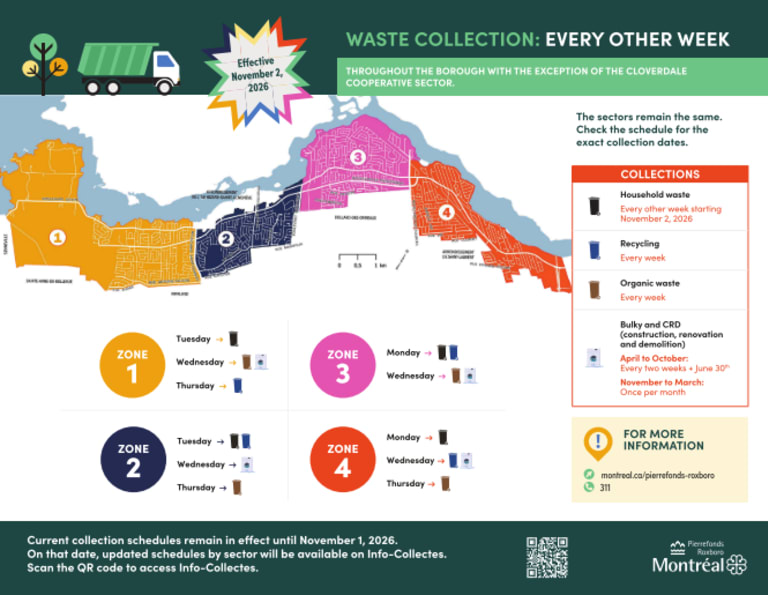
Starting November 2, 2026.
What
- Transition to biweekly household waste collection (black bin)
- Organic waste (brown bin) and recyclables (blue or green bin) will continue to be collected weekly.
- The map of the new zones introduced in the fall of 2025 (4 sectors) and the collection days will remain unchanged.
- The current collection schedule remains in effect until November 1, 2026.
Where
Throughout the borough, with the exception of the Cloverdale Cooperative sector.
Since L’Île-Bizard–Sainte-Geneviève will also be making the transition at the same time, Pierrefonds-Roxboro residents whose waste collection services are provided by that borough will be affected as well.
Why
- To improve operational efficiency, reduce greenhouse gas emissions, and encourage better sorting practices to decrease waste at the source.
- To meet a requirement of the Communauté métropolitaine de Montréal (CMM), whose objective is to limit waste collection services to a maximum of 26 pickups per year by December 2027.
Who
- Montréal is one of the 82 municipalities in the Communauté métropolitaine de Montréal that must comply with this regulation.
- The boroughs of Saint-Laurent, Verdun, and Mercier–Hochelaga-Maisonneuve already provide biweekly garbage collection, and other boroughs will adopt this schedule in the coming years.
- Starting this fall, the boroughs of Pierrefonds-Roxboro and L’Île-Bizard–Sainte-Geneviève, as well as a section of Villeray–Saint-Michel–Parc-Extension and Ahuntsic-Cartierville, switch to a two-week collection schedule for waste only.

Best sorting practices to adopt
Improving waste collection also means improving sorting at the source. We encourage you to adopt good sorting habits to facilitate waste processing and reduce your environmental impact.
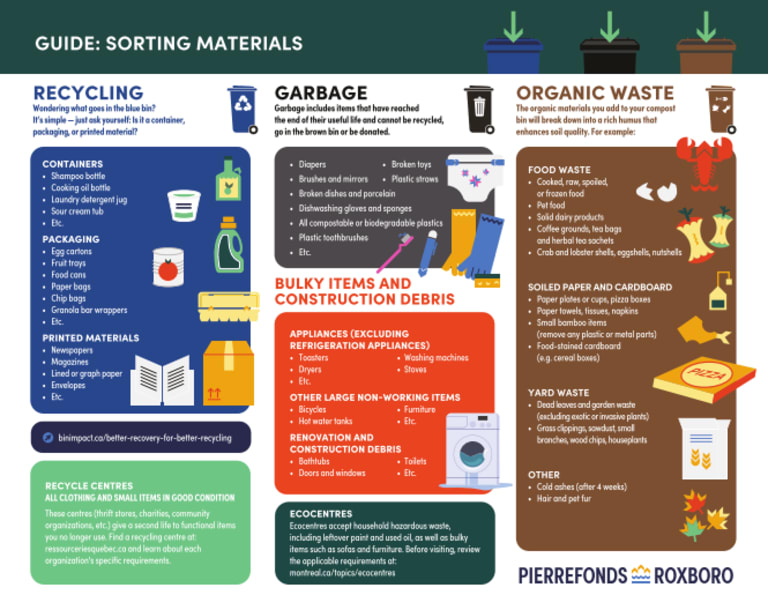
- Recycling bin: Containers and packaging made of paper, cardboard, glass, plastic, or metal, as well as printed materials such as newspapers and flyers.
- Compost bin: Food scraps, soiled paper and cardboard, yard waste, and certain biodegradable materials like hair or litter from herbivorous animals.
- Reuse centres(donation and recycling centres, thrift stores, etc.): Clothing and small items in good condition.
- Ecocentres: Bulky items and household hazardous waste.
- Bulky waste and construction materials (CRD): Appliances (except refrigerators), such as toasters, stoves, washers, and dryers. CRD also includes large items that no longer work and renovation waste: bicycles, furniture, bathtubs, doors, etc.
- Waste bin: Non-recyclable and non-compostable items (that are not hazardous), such as diapers, toothbrushes, broken dishes, sponges, or soiled containers
Please note: Grants are available to citizens for reusable items such as cloth diapers.
Reminder: a single black bin
As of fall 2025, the use of the provided compliant black bins is mandatory for waste collection. Plastic bags left at the curb, metal trash cans, or any other non-compliant containers are no longer accepted. No excess trash may be placed outside the provided black bin.
Important: The City of Montréal does not provide waste bins to commercial, industrial, and institutional establishments. The owners of these establishments must obtain their own compliant bin(s) for the municipal waste collection.

The Borough has distributed a new compliant black bin to all addresses, except those where citizens already owned one. If you still do not have yours or have had yours broken or stolen, please contact 311.
Questions about the service frequency change and the use of the black bin
- Optimize the sorting of your waste to free up space in your garbage bin.
- Talk to a neighbour about sharing any available space in their bin.
- Make use of all available collection services and bring eligible items to the ecocentre.
- Be mindful of your consumption habits.
- Whenever possible, choose reusable products and buy items in bulk.
Materials that do not fit inside a compliant bin cannot be collected.
No. Waste that causes odours, such as food scraps, is compostable and will continue to be collected weekly through the compost collection program. Proper sorting of materials therefore helps prevent this issue.
The only odour-causing waste that cannot be placed in the compost bin is animal waste (including cat litter), as well as personal hygiene products such as diapers, tampons, sanitary pads, and similar items.
To help limit odours from these materials, it is recommended that animal waste be placed in securely sealed bags. Many diaper disposal pails can also be used for pet waste.
In addition, the use of reusable products, such as cloth diapers, menstrual cups, period underwear, and washable sanitary pads, helps reduce odours, decrease the volume of waste sent to landfill, and lower long-term costs. According to the Groupe de recommandations et d’actions pour un meilleur environnement (GRAME), a complete set of cloth diapers costs approximately $500, whereas disposable diapers can cost as much as $2,000 for a single child.
Finally, Pierrefonds-Roxboro offers grants for these products, including cloth diapers for babies, sustainable menstrual products, and sustainable personal hygiene products for adults. Learn more about the eligibility requirements for these environmentally friendly and cost-saving grant programs.
If your bin is damaged, we encourage you to have it repaired. The City offers a free at-home repair service. You can submit a request by calling 311.
The 360-litre bin is the largest size provided by the City of Montréal to residents. This size corresponds to the authorized limit of household waste that a resident can place at the curb for municipal collection, according to the regulations in place.
However, households that properly sort their waste at the source should not generate enough garbage to require a 360-litre bin with the increase in collection services offered in recent years (recyclables, organics, construction, renovation and demolition waste and bulky items). This is why the 240-litre bin has been chosen.
The bin remains the property of the City and is assigned to a specific address. If you move, the bin must remain at the property.
Letters and notices
Quick search
Need help?
Contact us if you have questions.